


My Top 10 FireSmart Plants
Creating a more wildfire-resilient landscape does not mean giving up a beautiful, abundant garden! In fact, some of my favourite ornamental and native plants also happen to have characteristics that make them good choices for FireSmart landscapes on Southern Vancouver Island.
My Top 5 FireSmart Native Plants
California Aster (Symphyotrichum chilense)

California Aster is one of our keystone native plant species, with its masses of lavender-coloured, daisy-like flowers that bloom later in the summer, providing both colour and an important source of food for pollinators. California Aster is a more drought-tolerant variety of Aster and they work beautifully in both sunny naturalistic plantings and mixed into ornamental gardens.
Asters are very low maintenance and their herbaceous above-ground foliage should be cut back after it fades in early winter.
Red Flowering Currant (Ribes sanguineum)

Red Flowering Currant is easily one of my favourite native shrubs with its clusters of pink flowers that appear in early spring and provide an important nectar source as many native pollinators are waking up. After its done blooming, its foliage and structure still benefit as habitat and seasonal interest. As a deciduous broadleaf shrub with an open growth habit, it offers a very different fuel structure than dense evergreen conifers. I love using Red Flowering Currant as part of deciduous hedgerows that can act like ember breaks, mixed shrub borders, and naturalized pollinator gardens.
Red Flowering Currant only requires pruning every couple of years to remove dead wood and to train the shape; just be sure to prune it away from structures and prevent it from becoming a fire ladder.
Evergreen Huckleberry (Vaccinium ovatum)

Evergreen Huckleberry is one of my favourite native shrubs for gardens because it offers year-round evergreen foliage without needles. Its small glossy leaves, beautiful vibrant red new growth, delicate bell-shaped flowers, delicious edible berries, and wildlife value make it an incredibly versatile landscape plant with the added benefit of being wildfire-resilient. I love planting it in mixed hedgerows or as a shrub for winter interest in primarily herbaceous gardens.
For FireSmart purposes, I prefer allowing Evergreen Huckleberry to maintain a relatively open natural form rather than repeatedly shearing it into a very dense shrub or hedge since heavily shaped hedges can develop dense branching and accumulate dead material internally, potentially increasing fire risk. Keep the maintenance simple by just lightly pruning for shape and removing dead material below - that's it!
Lewis' Mock Orange (Philadelphus lewisii)

I think that Lewis' Mock Orange deserves to be planted far more often. In early summer its covered in beautiful jasmine-scented white flowers, creating a spectacular display while supporting insects and adding wonderful fragrance to the garden. It has a lovely arching growth habit and can be grown as a part of a hedgerow or simply as a feature shrub in everyday gardens. It is deciduous, highly adaptable to different growing conditions, and can be incorporated into both naturalized and ornamental gardens easily.
Lewis' Mock Orange will require periodic thinning of older stems, which also helps maintain an open structure and reduces the amount of dead woody material within the plant. As with any medium to large shrub, I make sure to pay attention to mature size and proper spacing.
Serviceberry (Amelanchier alnifolia)

Serviceberry AKA. Saskatoonberry is a truly multi functional addition to any garden. It has beautiful spring flowers, absolutely delicious edible berries, a ton of wildlife value as habitat, attractive fall colour, and an open, deciduous growth habit. Depending on growing conditions, Saskatoon can develop into a large multi stemmed shrub or be trained more like a small tree. For an edible landscape, food forest, native garden, or mixed FireSmart planting, it is an incredibly useful species.
Serviceberry requires minimal maintenance and maintenance needs will differ depending on if you are growing it as a shrub or small tree. Shrubs should be pruned to ensure they do not become fire ladders and the small trees should be pruned away from surrounding trees, shrubs and structures.
Special Mention: Native Sedges (Carex spp.)

Sedges are one of the best FireSmart alternatives to ornamental grasses. Many ornamental grasses produce large amounts of fine, dry material as they mature and FireSmart specifically identifies many ornamental grasses as hazardous. Native sedges can give us that same soft, grassy texture at a much smaller scale and with much more resilient foliage. There are dozens of different species of natiuve sedges, some better suited to full sun and drier soils and others as wetland plants. Some can even be used as groundcovers, planted beneath shrubs, or woven through naturalistic garden beds.
The only maintenance you will need to keep in mind is to keep plants appropriately hydrated and remove dead foliage when it accumulates.
My Top 5 FireSmart Ornamental Plants
Mexican Daisy (Erigeron kasavankis 'Profusion')

If I could tuck one flowering perennial into almost every sunny garden, this might be it. Mexican Daisy forms a low mound covered in masses of small daisy-like flowers, often blooming for an incredibly long time. The flowers open white and gradually develop pink and lavender tones, creating a soft, informal look that works beautifully along pathways, in rock gardens, cascading down retaining walls, and in mixed borders alongside other FireSmart plants. Its lack of woody framework and low-growing habit is particularly useful in FireSmart gardens because shorter vegetation generally reduces fire ladders.
Mexican Daisy requires minimal maintenance and only needs to be trimmed every fall and be diligent to remove dry material as it accumulates, particularly heading into our driest part of summer.
Catmint (Nepeta racemosa 'Walkers Low')

Catmint is one of my favourite wildfire-resilient alternatives when someone wants the soft purple haze of Lavender. Unfortunately, Lavender develops a woody framework and contains large amounts of highly flammable aromatic volatile oils. Luckily, Catmint can provide a surprisingly similar visual effect in the landscape with its deer-resilience, drought-tolerance and mounds of blue-purple flowers that are often covered in a variety of pollinators. Although Catmint is still aromatic and should not be treated as non-combustible, I prefer it over Lavender.
Catmint also requires minimal maintenance and just a good shearing it after its first major flush of flowers will encourage fresh growth while also removing drying stems and spent flowers.
Iris (Iris spp.)

Iris are almost perfectly designed for the kind of layered planting I like to use in my firescaping designs. Their broad, fleshy leaves contain considerably more moisture than most other plants making them considered fire-resilient and drought-tolerant. They provide bold architectural flowers and even their foliage has visual presence without creating a large woody mass. There are hundreds of beautiful ornamental iris available, which means they can fit into everything from formal gardens to cottage gardens. Just be sure to avoid planting some of the invasive varities of Iris such as Yellow Flag Iris!
The most important maintenance task comes later in the season once foliage becomes brown and dry, simply remove it!
Rhododendron (Rhododendron spp.)
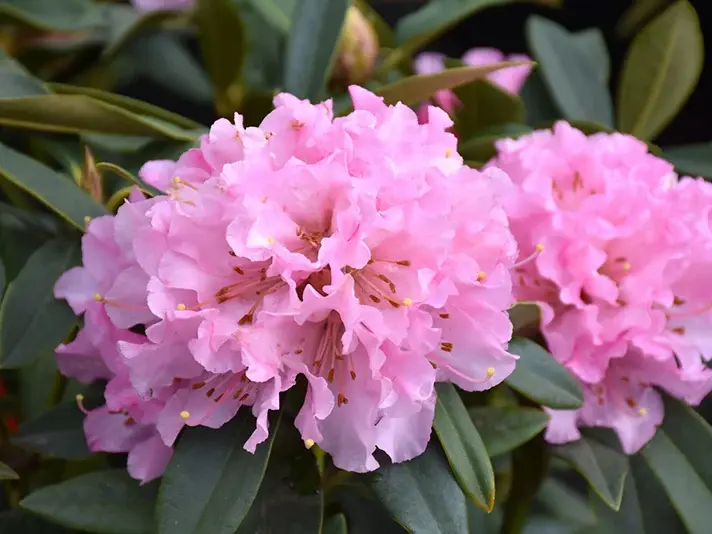
Rhododendrons can provide the evergreen structure people often want from arborvitae and other ornamental conifers without relying on high-resin, needle-bearing plants. I especially like using rhododendrons as part of mixed shrub plantings, and breaking vegetation into groups separated by lower plants, pathways, rock features, or other firebreaks. Rhododendrons can become large and woody with age, so location matters and be sure to keep mature size in mind when planting.
Rhododendrons will require moderate maintenance to keep them fire-resilient, mainly not allowing branches to grow against structures and regularly removing dead leaves, twigs, and woody material from underneath them. Even relatively fire-resistant shrubs should never be planted within the 1.5 metre (5ft) non-combustible zone around a home.
Fig Tree (Ficus carica)

Fig trees provide beautiful foliage, summer shade, habitat value, and a delicious edible harvest AND are amongst some of the most fire-resilient trees. What's not to love! The enormous, soft leaves contain plenty of moisture during the growing season; they are incredibly drought-tolerant once established, and the smooth-barked tree contains non-flammable latex sap which increases its fire resiliency.
Figs are deciduous trees which means that raking up the fallen leaves and dead branches is important. Be sure to prune the tree annually in late winter to maintain a FireSmart shape (all branches should be at least 2 metres above the ground) and to keep the tree appropriately spaced from your house and other structures.


